Atacama Large Millimeter/submillimeter Array (ALMA) - Taiwan
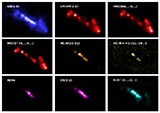
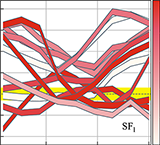
The ALCHEMI Atlas: Principal Component Analysis Reveals Starburst Evolution in NGC 253
Some galaxies host so-called starburst phenomena, characterized by the intensive formation of stars. The ALCHEMI team has conducted a wide-frequency spectral scan in the starburst galaxy NGC 253 using the
(...more)
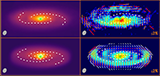
The ALMaQUEST Survey. XII. Dense Molecular Gas as Traced by HCN and HCO in Green Valley Galaxies
We present ALMA observations of dense gas tracers HCN (1−0) and HCO+ (1-0) for three green valley galaxies and two galaxies on the star-forming main sequence, all with comparable molecular
(...more)
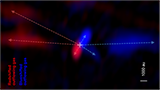
Multiple Outflows around a Single Protostar IRAS 15398−3359
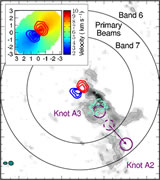
Protoplanetary disks, that are rotating disks of gas and dust surrounding young stars, become the birthplace of planets. However, details of the formation process of these disks remain unclear. In
(...more)
Polarization Substructure in the Spiral-dominated HH 111 Disk: Evidence for Grain Growth
In the early phase of star formation, protostellar disks are formed to grow the central protostars into stars. The disks will later evolve into protoplanerary disks to form planets like
(...more)
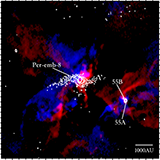
Multiple Misaligned Outflows and Warped Accretion Flows in the Proto-multiple System Per-emb-8 and 55
Multiple systems are common outcome in the star-forming regions. However, the formation process of multiple system remains unclear due to the complex dynamic. To address this, we analyze the ALMA
(...more)
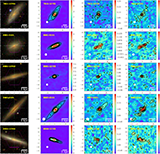
The ALMaQUEST Survey. XIII. Understanding Radial Trends in Star Formation Quenching via the Relative Roles of Gas Availability and Star Formation Efficiency
Star formation quenching refers to the process by which galaxies cease forming stars, transitioning from actively star-forming to passive states. Many mechanisms have been proposed to explain star formation quenching.
(...more)
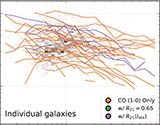
Resolved Measurements of the CO-to-H2 Conversion Factor in 37 Nearby Galaxies
The molecular phase of the interstellar medium (ISM) hosts star formation. Measuring its properties, e.g. density and kinematics, is key to understanding star formation and ISM properties. The low-J CO
(...more)
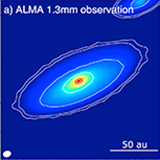
Multiple Shells Driven by Disk Winds: ALMA Observations in the HH 30 Outflow
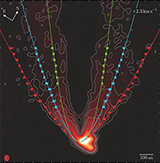
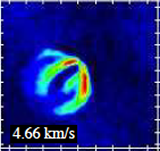
Left panel: The 12CO (J = 2–1) molecular line emission at 2.3 km s−1 with respect to the systemic velocity of the monopolar outflow associated with the protostellar system HH
(...more)
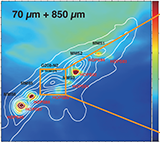
Title: A Dragon's Eye Hidden in Orion's Sword
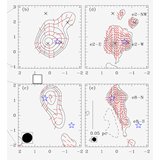
left: 850 μm continuum emission of the northern part of OMC-3 region including G208-N2 observed with the JCMT SCUBA-2 (Yi et al. 2018) in contours overlaid on the Hershel PACS
(...more)
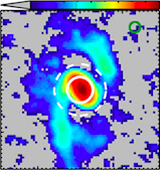
Early Planet Formation in Embedded Disks (eDisk). XIV. Flared Dust Distribution and Viscous Accretion Heating of the Disk around R CrA IRS 7B-a
With the ALMA large program eDisk, we identified hot dust disks
around a number of protostars. One of such objects, R Cr A IRS 7B-a, exhibits
a peak brightness temperature
(...more)
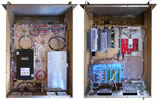
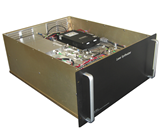
MZM Laser Synthesizer, ALMA Project
Internal photos of the Laser Synthesizer instrument. Left - top view of optical components including FBG assembly that houses optical filters, couplers and switch; Amonics erbium doped fiber amplifier along
(...more)
Local Oscillator Reference Test Module, ALMA Project
Internal photos of LORTM instrument. Left - top view of optical components including Sumitomo Mach Zehnder modulators (x2), Centellax RF power amplifiers (x2), Amonics erbium doped fiber amplifier, fiber Bragg
(...more)
The role of molecular gas in suppressing star formation in galaxies
Left panels: The distributions of molecular gas for three MaNGA-selected green valley galaxies (from top to bottom: Galaxy 1, Galaxy 2, and Galaxy 3) based on ALMA CO observations. Middle
(...more)
A First Glimpse of ALMA at the High-Mass Star-Forming Region W51
Improvement in resolution and sensitivity from SMA subcompact (left, resolution of 2”) to SMA extended (middle, resolution of 0.7”) to ALMA (resolution of 0.26”) towards the high-mass star-forming cores W51
(...more)
Epitaxial ultrathin NbN superconducting films for Terahertz application
We have realized the epitaxial growth of ultrathin δ-NbN films on 3C-SiC/HRSi substrates. Even with a thickness of 1.3 nm (~3 unit-cells), the δ-NbN film shows a superconducting transition above
(...more)
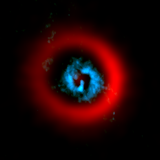
Spirals inside a dust gap of a young star forming disk
ALMA image of the dust ring (red) and gaseous spirals (blue) of the circumstellar disk AB Aurigae.
(...more)
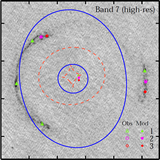
The Innermost Mass Distribution of the Gravitational Lens SDP.81 from ALMA Observations
High-resolution Band 7 continuum negative image of SDP.81. This is the highest-resolution submillimeter observation of a strong lensing galaxy to date.
(...more)
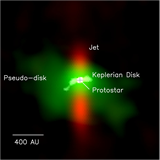
ALMA Revealing the Pseudo-disk, Keplerian Rotating disk, and Jet in the Very Young Protostellar System HH 212
Figure 1: ALMA composite image of HH 212, showing a pseudo-disk (green) and a Keplerian disk (bright green) in dust continuum, and a bipolar jet in HCO+ gas (red). (Lee
(...more)
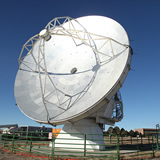
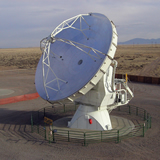
NA 12m Vertex prototype antenna at the JVLA site in Socorro, New Mexico.
NA 12m Vertex prototype antenna at the JVLA site in Socorro, New Mexico.
(...more)
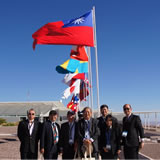
Delegation from Taiwan during the ALMA inauguration in March 2013 at the OSF in Chile.
Delegation from Taiwan during the ALMA inauguration in March 2013 at the OSF in Chile.
(...more)
the procured NA 12m Vertex prototype antenna at the JVLA site in Socorro, New Mexico.
the procured NA 12m Vertex prototype antenna at the JVLA site in Socorro, New Mexico.
(...more)
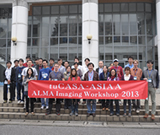
the latest tuCASA-ASIAA imaging workshop held at National Normal University ShiDa
the latest tuCASA-ASIAA imaging workshop held at National Normal University ShiDa
(...more)
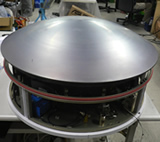
Nutating subreflector in the laboratory at ASIAA.
(...more)
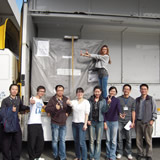
EA-FEIC staff members celebrating the delivery of the very last front-end for Europe in 2012.
EA-FEIC staff members celebrating the delivery of the very last front-end for Europe in 2012.
(...more)
EA FEIC team delivering the first front end to Chile in 2008.
EA FEIC team delivering the first front end to Chile in 2008.
(...more)
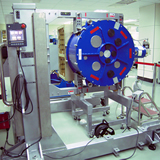
the front ends during testing and integration at the EA FEIC
One of the front ends during testing and integration at the EA FEIC in Taichung, Taiwan. Pictured is the tilt table holding the cryogenic dewar (in blue) in which the
(...more)
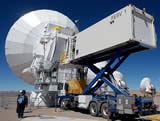
1st Front End Service Vehicle (FESV) arrived AOS
After its month-long journey from Taiwan, the first of the two Front-End Service Vehicles is being tested at the ALMA Operations Support
Facility in Chile. In this photo, the FESV
(...more)
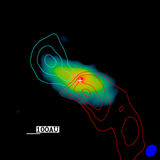
Circumstellar disk and ambient gas surrounding the protostar, L1489 IRS
Circumstellar disk and ambient gas surrounding the protostar, L1489 IRS (white cross), from an ALMA cycle-0 observation with an integration time of 74 minutes at a resolution of 1" (blue
(...more)
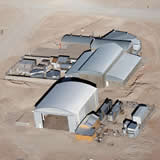
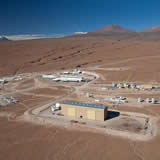
An aerial view of the technical building at the AOS at 5000m
An aerial view of the technical building at the AOS at 5000m
(...more)
Aerial view of the Operations Support Facilities (OSF) at around 2900m.
To the right are the three antenna assembly sites belonging to the Japanese, North American and European partners; in the upper middle section is the operations building, and in the
(...more)
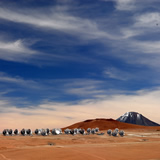
ALMA antennas on the Chajnantor plateau in Chile
ALMA antennas on the Chajnantor plateau in Chile. (Picture Credit: C. Padilla, ALMA, ESO/NAOJ/NRAO)
(...more)
Installation of the nutating secondary subreflector on an ALMA antenna for the site acceptance test
Installation of the first ALMA nutator in Chile. January 2013
(...more)
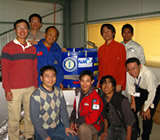
EA-FEIC staff members celebrating the delivery of the last receiver front-end system for our ALMA-Japan partner
EA-FEIC staff members celebrating the delivery of the last receiver front-end system for our ALMA-Japan partner (blue cylinder-shaped object in the middle of the photo).
(...more)
ALMA nutator SAT
First ALMA nutator on a N.A. antenna, january 2013
(...more)
ALMA detection of the rotating molecular disk wind from the young star HD 163296
Blue shifted disk wind from HD 163296.
The grey-scale shows the CO J=2-1 integrated intensity of the blue shifted wind from HD 163296. The 4σ level is indicated by the
(...more)
Unveiling the gas and dust disk structure in HD163296 using ALMA observations
The CO J=3-2 channel map unveils for the first time at sub-millimeter frequencies the vertical structure details of a protoplanetary disks, showing the back and front side of the flared
(...more)
ALMA imaging of the CO snowline of the HD163296 disk with DCO+
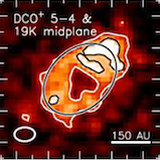
Integrated emission map of H13CO+ (4-3) with contours showing 3, 5 and 7 sigma (left), and DCO+ (5-4) with contours showing 3 and 5 sigma. The H13CO+ is centrally peaked
(...more)
Giant molecular clouds and star formation in the tidal molecular arm of NGC 4039
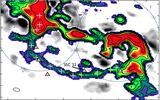
CO(2-1) integrated intensity map of the newly discovered molecular arm close to NGC4039 (Espada et al. 2012 ApJ, 760L, 25E). The plus signs indicate the clumps.
(...more)
Cryogenic IF Low Noise Amplifier
Cryogenic IF Low Noise Amplifier (LNA) for ALMA for 4-12 GHz using 0.15 mHEMT
(...more)
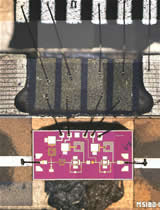
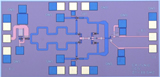
Voltage-Controlled Oscillator for ALMA Band-1
Voltage-Controlled Oscillator MMIC for ALMA Band-1 using 2um GaAs HBT
(...more)
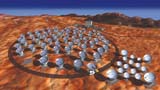
Conceptual image of ALMA
Conceptual image of ALMA, which is currently under construction. ALMA will consist of the“12m Array” of up to sixty-four 12 m telescopes, and “Atacama Compact Array (ACA)”of four 12m and
(...more)
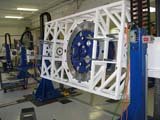
Dewar of the ALMA receiver
Left: To install receiver cartridges into a dewar, the dewar is mounted on a “tilt table” to give sufficient space for the installation of the cartridge. In the picture, the
(...more)
Signing Ceremony between NINS and AS
In September 2005, Academia Sinica (AS) signed an agreement with National Institutes of Natural Sciences of Japan (NINS) to join the ALMA-Japan project. AS President Yuan T. Lee shakes hands
(...more)